

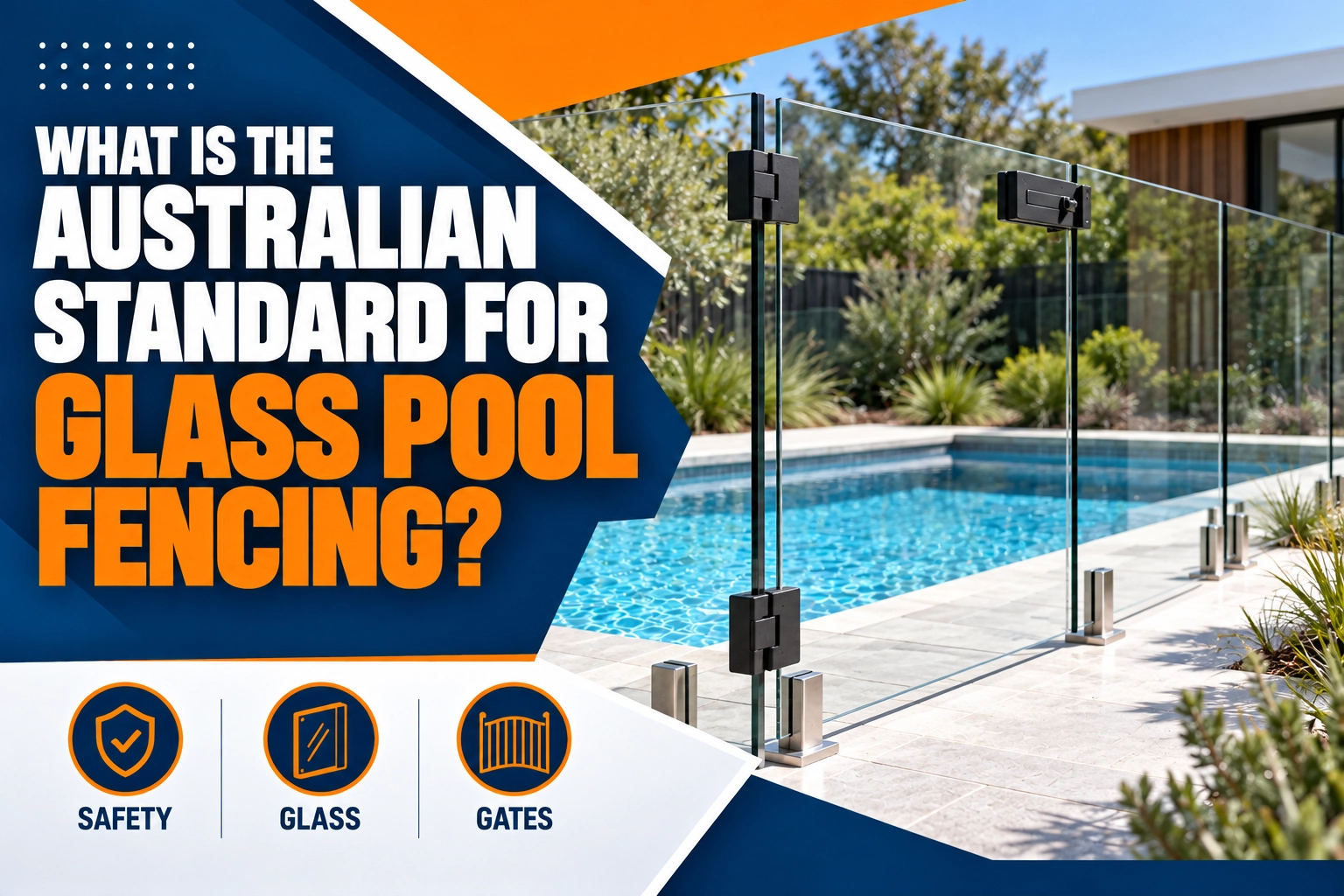
Glass pool fencing in Australia needs to satisfy both pool-barrier requirements and glass-selection requirements.
AS 1926.1 covers the safety barrier, including gates, access and non-climbable areas. AS 1288:2021 covers the selection and installation of glass. The current safety-glazing standard is AS/NZS 2208:2023, Safety glazing materials in buildings.
The latest published pool-barrier standard is AS 1926.1:2024, but that does not automatically mean the 2024 edition applies to every existing pool. State or territory law, the Building Code and the pool’s approval history can affect which requirements apply.
| Standard | Main role |
|---|---|
| AS 1926.1:2024 | Pool safety barriers, gates and access control |
| AS 1288:2021 | Glass selection, strength, support and installation |
| AS/NZS 2208:2023 | Safety-glazing testing and classification |
| State/territory requirements | Determine what legally applies to the property |
The 2024 revision clarified definitions and diagrams, expanded guidance on non-climbable zones and updated gate-component requirements and durability testing.
AS 1926.1:2024 Glass Pool Fencing Requirements
AS 1926.1:2024 is designed to restrict unsupervised access to swimming pools by young children.
For a glass pool fence, that means looking at the complete barrier, not just the glass panels.
Important areas include:
- effective barrier height
- gaps and openings
- non-climbable zones
- gate operation
- hinges and latches
- surrounding furniture, plants and structures
- changes to paving or ground levels
The gate matters as much as the glass
A pool gate needs to continue closing and latching properly after installation.
Loose fittings, changed hinge alignment, dragging or landscaping that interferes with movement can all affect operation. If a gate stops closing or latching reliably, secure access to the pool and arrange prompt assessment.
A homeowner can identify a problem. That does not amount to formal compliance certification.
AS 1288:2021 and Glass Pool Fencing
AS 1288:2021 covers how glass is selected and installed. It considers glass strength and human-impact safety, as well as relevant loads, supports and installation methods.
There is no universal glass thickness for every frameless or semi-frameless pool fence.
The correct specification can depend on:
- panel dimensions
- support arrangement
- fixing system
- design loads
- wind exposure
- barrier configuration
- the structure receiving the fixings
Glass, hardware and substrate therefore need to be considered together.
AS 1926.1:2024 requires Grade A safety glass for glass pool barriers and provides pathways for determining appropriate glass thickness through AS 1288:2021 or the relevant testing provisions.
Accurate measurements are particularly important when ordering custom glass panels. Professional glass cutting services in Adelaide can help provide correctly sized panels for suitable residential and commercial glazing applications.
What if the fence also protects a drop?
A pool barrier can sometimes also act as fall protection.
Where the glass barrier protects a fall greater than 1,000 mm, additional AS 1288 requirements apply. This is a design and installation issue and should not be treated as a standard pool-fence specification.
What Type of Glass Is Used for Pool Fencing in Australia?
Toughened safety glass is widely used for frameless and semi-frameless pool fencing. When correctly specified, it provides high strength and good impact performance while preserving clear sightlines around the pool.
Laminated safety glass may also be used in suitable systems. Its interlayer helps retain glass after breakage.
| Glass type | Breakage behaviour | Main consideration |
|---|---|---|
| Toughened safety glass | Breaks into smaller fragments rather than large sharp shards | Must be correctly specified for the panel and support system |
| Laminated safety glass | Interlayer helps retain broken glass | Composition and system must suit the application |
| Annealed glass | Can form large sharp fragments | Not a substitute where Grade A safety glazing is required |
Outdoor suitability depends on the complete system: glass, fittings, hardware, supports and installation conditions all matter.
Homeowners comparing different glazing products can also explore the differences between laminated glass and double glazing to better understand their construction and typical applications.
Safety glass can still cause injury when broken. If a panel is cracked or shattered, do not handle it or attempt a temporary repair. Restrict access to the pool area and arrange professional assessment.
Glass Pool Fence Height and Safety Requirements in Australia
AS 1926.1:2024 specifies a minimum 1,200 mm height for internal barriers, but height is only one part of compliance.
Openings, finished ground level, climbing opportunities and objects near the barrier also matter.
For South Australia specifically, current government guidance also sets separate requirements for boundary barriers, including a 1.8 metre height on the pool side. This should not be treated as a universal national boundary-fence requirement.
Homeowners should also check:
- gaps beneath and through the barrier
- climbable horizontal features
- nearby furniture
- garden structures and plants
- retaining walls
- changes to paving or surrounding levels
Glass Pool Fence Gate Requirements
In South Australia, current guidance requires pool gates to swing away from the pool area, self-close from any position and use an appropriately positioned latching device.
Homeowners should periodically check that:
- the gate closes without being pushed
- the latch engages correctly
- hinges and fittings remain secure
- the gate has not started dragging
- latch and hinge alignment remains correct
- landscaping does not obstruct movement
Never prop a pool gate open or disable its closing or latching function.
Frameless vs Semi-Frameless Glass Pool Fencing
Both systems can meet the applicable requirements when properly designed and installed.
| Feature | Frameless | Semi-frameless |
|---|---|---|
| Visibility | Minimal visual interruption | Clear views with visible posts |
| Support | Spigots, channels or structural fittings | Posts and panel fittings |
| Installation | Fixings and supporting substrate must suit the system | Post positions, foundations and panel fittings must suit the system |
| Maintenance | Glass, fittings and gate checks | Glass, posts, fittings and gate checks |
| Budget | May cost more for comparable installations | May be more economical, although site conditions can change the comparison |
The better option depends on the pool layout, available fixing surfaces, ground and support conditions, gate position and overall design.
Neither system is automatically safer or more compliant.
How to Make Sure Your Glass Pool Fence Is Compliant
Before approving an installation:
- Identify the applicable jurisdiction and Standard edition.
- Confirm the glass specification and how its suitability was determined.
- Check the complete barrier layout, including height, gaps and surroundings.
- Check non-climbable zones, including furniture, landscaping and pool equipment.
- Check gate operation, including closing and latching.
- Confirm the support system, including glass, hardware, fixings and substrate.
- Ask what approvals, inspections and documentation are required or supplied.
- Maintain the barrier after installation, including glass, hinges, latches and fittings.
Compliance belongs to the complete barrier system, not simply the glass.
For a more detailed breakdown of material and installation expenses, read our guide to glass pool fencing costs in Australia.
Which Pool-Fencing Rules Apply in South Australia?
South Australia remains on NCC 2022 Amendment 2 for its Building Code until 30 April 2027, with NCC 2025 scheduled to apply from 1 May 2027.
Pool age also matters.
Pools built on or after 1 July 1993 must comply with the rules that applied when the construction application was submitted.
For pools built before 1 July 1993, different requirements can apply. A property sale can also trigger upgrade obligations.
Two assumptions should therefore be avoided:
- an old fence is compliant simply because it has always been there
- every old fence must automatically satisfy the newest published Standard
Required safety features still need to remain operational.
Common Glass Pool Fencing Compliance Mistakes
Common problems include:
- unsuitable glass or hardware
- poor installation or unsuitable fixing conditions
- incorrect gaps or openings
- a gate that no longer self-closes
- incorrect latch positioning
- loose hinges or fittings
- new furniture or landscaping creating climbing opportunities
- paving changes affecting effective barrier height
- damaged glass
- assuming “toughened” automatically means compliant
An older barrier should be checked against the requirements that apply to that property, not judged solely by its age or by the newest Standard.
Does Glass Pool Fencing Need to Comply With Australian Standards?
Australian Standards are not automatically laws simply because they are published.
They can become mandatory when legislation, building regulations or another binding instrument refers to them. Contracts can also require compliance separately.
Our glass replacement services cover a range of residential and commercial glazing requirements. If you need to handle glass debris, read our guide on how to dispose of broken glass safely. Do not attempt to dismantle a damaged pool barrier yourself.
For a homeowner, the practical question is:
How Much Does Compliant Glass Pool Fencing Cost?
There is no meaningful single national price.
Cost can change with:
- frameless or semi-frameless design
- glass specification
- fence length
- number of gates
- fixing system
- concrete, tiles or other substrates
- site access
- removal of existing fencing
- custom panels or complex layouts
Compare complete installed scopes rather than headline per-metre prices.
For additional information, explore our detailed glass pool fencing cost guide.
Why Choose Professional Glass Pool Fence Installation?
The value of professional installation is having the glass, support system, gate and site conditions considered together.
Before accepting a quote, ask:
- Which requirements apply to this project?
- What glass is being specified?
- What hardware and fixing system will be used?
- Has the substrate been assessed?
- Does wind exposure affect the design?
- What documentation will be supplied?
- Who handles required approvals or inspections?
Those questions make quotes easier to compare than asking only whether a fence is “Australian Standard compliant”.
At 313 Glass & Aluminium, we provide glazing solutions for residential and commercial properties, including custom glass cutting in Adelaide and professional glass replacement.
Australian Standard Glass Pool Fencing Checklist
| Check | What to confirm |
|---|---|
| Glass | Appropriate safety glazing |
| Barrier | Applicable requirements identified |
| Height and gaps | Correct for the project |
| Non-climbable areas | Remain clear |
| Gate | Closes and latches correctly |
| Hardware | Secure and suitable |
| Surrounds | Do not compromise the barrier |
| Maintenance | Glass, hinges, latches and fittings remain serviceable |
This is a homeowner checklist, not a compliance certificate.
Frequently Asked Questions
What Australian Standard applies to glass pool fencing?
AS 1926.1 covers pool barriers and AS 1288:2021 covers glass selection and installation. AS/NZS 2208:2023 is the current safety-glazing standard.
What is AS 1926.1:2024?
It is the latest published Australian Standard for permanent swimming-pool safety barriers. The 2024 revision clarified definitions and diagrams and updated non-climbable-zone and gate-component guidance.
Does glass pool fencing need to be toughened?
Grade A safety glass is required under AS 1926.1:2024. Toughened safety glass is commonly used, but type, thickness and support still need to suit the system.
What is AS 1288:2021?
It covers glass selection and installation, including strength, human-impact safety, support, fixing methods and relevant loads.
How high does a glass pool fence need to be?
AS 1926.1:2024 sets a 1,200 mm minimum for internal barriers. Other requirements, including boundary conditions, openings and non-climbable zones, also matter.
Does frameless glass pool fencing meet Australian Standards?
It can, provided the glass, hardware, substrate, gate and barrier configuration meet the applicable requirements.
Does a glass pool fence need a self-closing gate?
Where a gate forms part of the pool barrier, applicable closing and latching requirements must be met.
How do I know if my existing fence is compliant?
Start with the pool’s construction or approval date and location. If the applicable requirements are unclear, seek advice from the local council or an appropriately qualified professional.