
Choosing the right glass partition depends on your space, design preferences, and practical needs.
In this guide, you’ll explore the different types of glass partitions, learn how to choose the right option for your space, and understand what to expect before a glass office partition installation adelaide.
We’ll also compare the pros, cons and uses of each type and explain how privacy, safety, sound control, style, and budget can influence your decision.
Glass Partition Main Types by Your Priority
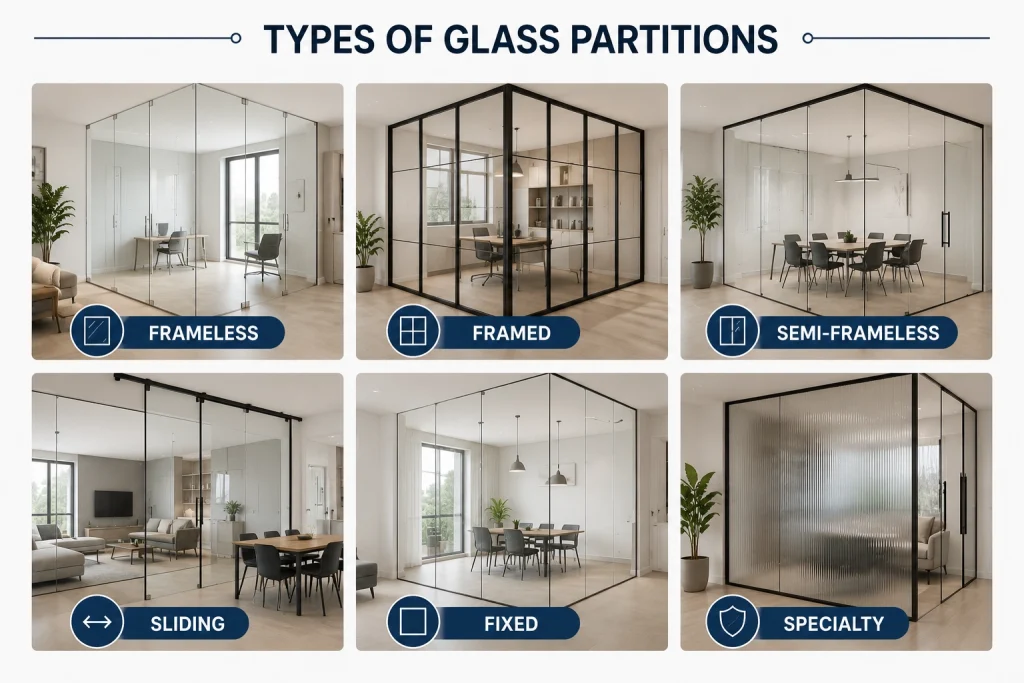
A glass partition can be fixed, sliding, framed, semi-frameless or fully frameless. It can also be clear, frosted, tinted or textured.
That means the term covers a wide range of products rather than one single design, which is why comparing the different types of glass partition carefully is important before making a final decision.
Frameless Glass Partitions
Best for: Modern homes, open-plan living areas, offices and minimalist interiors.
Advantages
- Creates a clean, premium appearance
- Maximises natural light
- Makes smaller rooms feel more open
- No bulky frame interrupts the view
- Easy to integrate with contemporary interiors
Disadvantages
- Provides limited privacy with clear glass
- Fingerprints and smudges are more visible
- Requires appropriate glass thickness and hardware
- Can cost more than basic framed systems
Key factors to consider: glass thickness, toughened vs laminated glass, hardware quality, door configuration and installation requirements.
Framed Glass Partitions
Best for: Offices, home offices, industrial interiors and areas where structural definition is important.
Advantages
- Provides strong structural support
- More design and configuration options
- Can accommodate different glass types
- Black and powder-coated frames can become a design feature
- Can provide better sealing than some frameless systems
Disadvantages
- More visible than frameless systems
- Can make a room feel visually heavier
- More frame surfaces require cleaning
- Frame finish affects the overall appearance
Key factors to consider: aluminium or steel frame, frame colour, glass type, door configuration and acoustic requirements.
Semi-Frameless Glass Partitions
Best for: Bathrooms, hallways, home offices and room dividers.
Advantages
- Good balance between appearance and support
- Less visual framing than fully framed systems
- Usually more affordable than premium frameless configurations
- Works with several glass finishes
Disadvantages
- Not as minimal as frameless glass
- Some framing remains visible
- Acoustic performance depends heavily on seals and construction
Key factors to consider: where the frame is positioned, glass thickness, hardware and privacy requirements.
Sliding Glass Partitions
Best for: Apartments, compact rooms and flexible open-plan layouts.
Advantages
- Saves floor space
- Does not require swing clearance
- Can quickly open or close a room
- Works well for temporary separation
- Maintains strong light flow
Disadvantages
- Sliding tracks require regular cleaning
- Rollers and hardware can eventually require maintenance
- Usually provides less acoustic sealing than a well-sealed fixed system
- Custom tracks and hardware can increase the price
Key factors to consider: track quality, panel weight, opening width, soft-close mechanism and acoustic sealing.
If your project includes a sliding door rather than a partition, factors such as sliding glass door sizes and the cost of sliding glass doors may also be relevant when planning the opening.
Fixed Glass Partitions
Best for: Permanent room separation, bathrooms, living areas and offices.
Advantages
- Simple and reliable
- No moving components
- Low maintenance
- Clean appearance
- Excellent way to divide a space without building a solid wall
Disadvantages
- Cannot be opened when required
- Does not provide flexible access
- Privacy depends entirely on the selected glass
Key factors to consider: panel dimensions, glass type, support method and whether a door may be required in the future.
Types of Glass Used in Glass Partitions
| Partition option | Privacy | Light flow | Sound control | Style impact | Typical use |
|---|---|---|---|---|---|
| Clear frameless | Low | Excellent | Low | Very modern | Living zones, open-plan areas |
| Frosted frameless | Medium to high | Very good | Low to medium | Clean and soft | Bathrooms, home offices |
| Framed clear glass | Low | Very good | Medium | Strong visual definition | Room dividers, studies |
| Sliding glass partition | Varies by glass type | Very good | Medium | Practical and flexible | Small homes, adaptable spaces |
| Laminated acoustic partition | Medium | Good | High | Functional and refined | Offices, media rooms |
| Textured glass partition | Medium | Good | Low to medium | Decorative | Feature dividers, bathrooms |
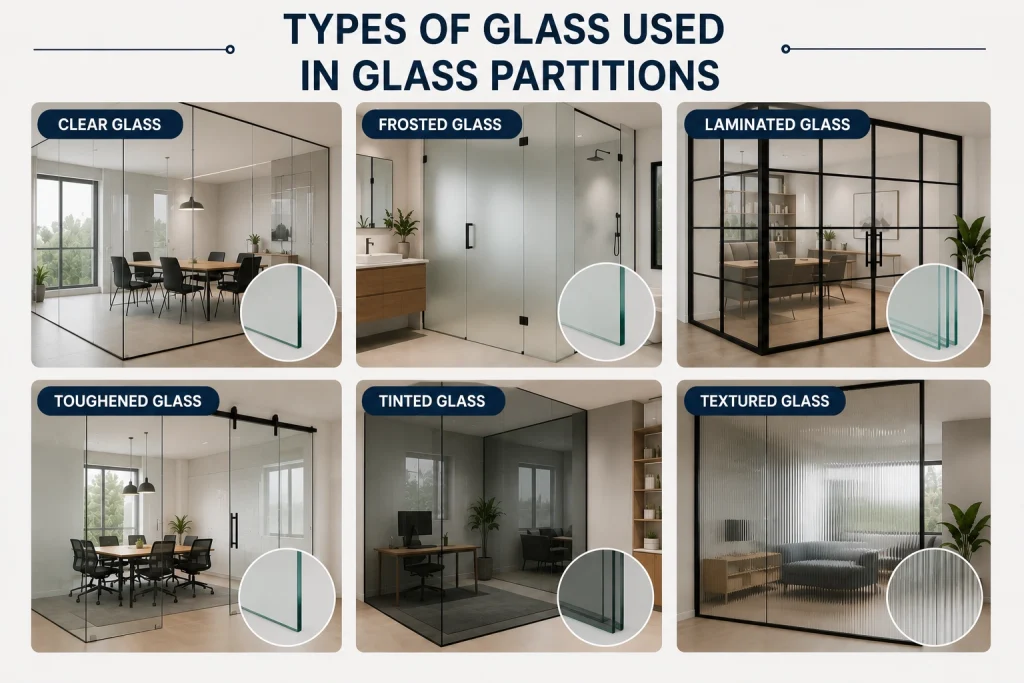
The style of partition matters, but the glass itself is just as important. Different glass types affect privacy, light, strength, appearance and cleaning requirements. That means two partitions with the same frame style can still perform very differently depending on the glass used.
For residential interiors, the most common options include clear glass, frosted glass, laminated glass, tempered glass, tinted glass and textured glass. Each one has its own strengths, and the right choice depends on the room and the result you want.
Clear Glass
Clear glass is the go-to option when you want maximum light and full visibility. It keeps rooms feeling connected and spacious, which is why it is often used in open-plan layouts and modern homes.
The main drawback is privacy. While clear glass looks sleek and bright, it does not hide much, so it is usually better for shared living areas than bathrooms or focused work zones.
Frosted Glass
Best for: Bathrooms, bedrooms, home offices and private areas.
Advantages
- Provides significantly better visual privacy than clear glass
- Still allows natural light through
- Works well with modern interiors
- Can reduce the visibility of fingerprints and everyday marks
- Available in different levels of opacity
Disadvantages
- Reduces visibility
- Does not automatically provide strong soundproofing
- Some custom frosting or decorative finishes increase cost
Key factors to consider: opacity level, etched vs film finish, cleaning requirements and whether full or partial frosting is required.
Laminated Glass
Best for: Home offices, media rooms, meeting spaces and areas where safety and sound control matter.
Advantages
- Interlayer helps hold glass fragments together if damaged
- Can provide better acoustic performance
- Available in different glass and interlayer configurations
- Provides an additional safety characteristic compared with ordinary monolithic glass
Disadvantages
- Heavier than single-pane glass
- More expensive
- Requires suitable framing and hardware
- Installation can be more complex
Key factors to consider: glass thickness, interlayer type, acoustic rating, frame design and panel size.
For a deeper comparison of laminated glass and insulated glazing, see our guide to laminated glass vs double glazing.
Toughened or Tempered Glass
Best for: Family homes, high-traffic areas and general residential applications.
Advantages
- Stronger than ordinary annealed glass
- Designed to break into smaller pieces when fractured
- Suitable for many residential applications
- Available in clear, frosted, tinted and textured finishes
Disadvantages
- Does not provide the same acoustic performance as specialist laminated glass
- Cannot be cut or modified after toughening
- Large panels can be heavy and require professional installation
Key factors to consider: thickness, panel dimensions, safety requirements, hardware and Australian glazing standards.
Tinted and Textured Glass
Best for: Contemporary interiors, offices and areas where glare reduction is useful.
Advantages
- Adds a distinctive design element
- Can reduce glare
- Provides some visual privacy
- Available in different colours and shades
Disadvantages
- Can make a room appear darker
- Colour affects the overall interior appearance
- Does not provide the same privacy as heavily frosted glass
- Darker glass may not suit every room
Key factors to consider: tint level, natural light, interior colour scheme, glare and privacy requirements.
Glass Partition Types by Application
Different rooms need different results. A partition that works beautifully in a hallway may not be the best choice for a bathroom or study. Looking at the application first often makes the selection process easier.
In living areas, homeowners usually prioritise light and style. In bathrooms, privacy and moisture resistance matter more. In home offices, sound control and visual separation become more important. Matching the partition to the room helps avoid overpaying for features you do not need or missing features you actually do.
Living Rooms and Open-Plan Areas
For living zones, frameless clear glass and large fixed panels are often the best fit. They preserve the openness of the layout while still helping define separate functions within the home.
These homes where open-plan design is common but zoning is still necessary. A partition can create a subtle boundary between lounge and dining spaces without making the home feel boxed in.
Bathrooms and Ensuites
Bathrooms usually need better privacy, easy cleaning and moisture-resistant materials. Frosted, textured or semi-opaque glass is often a better choice here than clear panels.
A well-chosen bathroom partition can make the space look lighter and more refined than a solid wall. It can also keep a room feeling open while still creating enough screening for everyday comfort.
When planning a walk-in shower, factors such as the minimum size for a walk-in shower can also influence the type and configuration of glass you choose.
For installation considerations, see our guide on how to install a shower screen.
Home Offices
Home offices benefit from partitions that allow light in while reducing distraction. Frosted, laminated or acoustic glass can work well depending on whether privacy or sound reduction is the top priority.
This has become more relevant for homeowners who need quiet work zones inside shared living environments. A good partition can make the office feel separate enough for focus without cutting it off from the rest of the home.
Best Glass Partition Types for Privacy
If privacy is your top concern, clear glass usually will not be enough on its own. Frosted, textured and some tinted options perform much better because they limit visibility while still allowing light into the room.
For residential use, frosted glass is often the most practical privacy solution because it feels modern, neutral and easy to integrate into most interiors. Textured glass is another strong option if you want privacy with a more decorative appearance. In very private areas, combining frosted glass with framed or semi-frameless construction can create a more enclosed and secure feel.
Best Glass Partition Types for Soundproofing
Glass partitions are not automatically soundproof. If reducing noise matters, the construction details become more important than appearance alone. The glass thickness, frame quality, seals and whether the glass is laminated all influence the result.
For better sound control, laminated acoustic glass partitions are usually the strongest option. Framed systems can also perform better than simple frameless panels because the added structure can support tighter seals. For a home office, study nook or media area, this can make a noticeable difference in daily comfort.
Best Glass Partition Types for Safety
Safety matters most in family homes, high-traffic zones and any area where accidental bumps are possible. In those cases, toughened glass and laminated glass are usually the preferred choices.
Tempered glass is common because it is strong and widely available, while laminated glass adds another layer of protection and can improve performance in other ways too. If children, pets or busy movement patterns are part of the household, choosing safety-rated glass should be treated as essential rather than optional.
Design Styles for Glass Partitions
The right partition should not only work well but also suit the style of the home. A very industrial framed partition may look great in one property and feel out of place in another. The finish, frame colour, hardware and glass type all affect the final look.
Frameless partitions tend to suit minimalist, coastal and contemporary homes. Black framed glass often works well in industrial or modern interiors. Frosted and textured finishes can soften a room and suit homes that want a little more warmth or subtle visual interest.
For projects that combine glass with steel framing, you can also explore steel and glass partition wall cost when considering the overall system and budget.
Minimalist Style
Minimalist interiors usually benefit from clear or lightly frosted frameless glass. The goal is to keep the space feeling simple, bright and uncluttered.
This style works especially well when the partition is meant to blend in rather than become a feature. Slim hardware and neutral finishes help maintain that clean effect.
Industrial Style
Industrial-style homes often suit framed glass with darker trims such as black aluminium or steel-look finishes. The frame becomes part of the design rather than something hidden.
This approach gives the partition stronger visual presence and can work well in loft-style spaces, renovated homes or interiors with timber, concrete and metal finishes.
Soft Contemporary Style
For softer contemporary homes, semi-frameless partitions, frosted glass and subtle textures can create a balanced finish. These styles feel modern without becoming too stark or cold.
This can be a good direction for family homes that want practicality and warmth together. It also suits interiors where the partition needs to feel integrated rather than dramatic.
How to Choose the Right Type of Glass Partition
Start by asking what problem the partition is meant to solve. Is it mainly about privacy, noise, layout, style or natural light? Once that is clear, the shortlist becomes much easier.
Then think about the room size, how the area is used, whether a door is required, and how much maintenance you are comfortable with. In many cases, homeowners benefit from keeping the design simple and prioritising performance over trend-based choices.
Questions to Ask Before You Decide
Consider whether the area needs full privacy or only visual separation. Think about whether a fixed panel is enough or whether access between spaces means a sliding or hinged system is necessary.
Also look at cleaning practicality, family safety and how the partition will work with the home’s existing finishes. A beautiful option on its own may not always be the best fit for the actual room.
Cost Factors for Different Types of Glass Partitions
The price of a glass partition can vary widely depending on size, glass type, hardware, framing, installation complexity and whether the design is custom. Frameless and acoustic systems usually cost more than simpler framed or fixed options.
Other cost factors include site access, the condition of surrounding walls and floors, special finishes, and whether the project includes doors or sliding tracks. labour and custom manufacturing can also affect the final price significantly, especially for non-standard openings or premium finishes.
Pros and Cons of Glass Partitions
Glass partitions offer a combination of function and visual appeal that solid walls often cannot match. They can increase light flow, make a home feel larger and help create distinct zones without losing openness.
At the same time, they are not the perfect solution for every room. Some options offer limited privacy, some show marks more easily, and high-performance systems can become expensive. Weighing the pros and cons early can help set realistic expectations.
| Pros | Cons |
| Lets natural light move through the home | Some styles provide limited privacy |
| Helps small areas feel larger | Clear glass shows fingerprints and smudges |
| Creates zones without heavy construction | Acoustic performance varies a lot |
| Can suit modern and classic interiors | Premium custom systems can be costly |
| Available in privacy and safety options | Poor selection can look cold or impractical |
Maintenance Tips for Glass Partitions
Glass partitions are usually straightforward to maintain, but the cleaning routine depends on the finish. Clear glass shows marks more quickly, while frosted and textured surfaces may hide some everyday smudges better. Regular wiping with a suitable glass cleaner and a soft cloth is often enough for general care.
It is also worth checking tracks, hardware and seals over time, especially for sliding systems. Keeping these components clean and in good condition helps the partition keep working properly and prevents a stylish feature from becoming frustrating to use.
Common Mistakes When Choosing Glass Partitions
- Choosing clear glass when the room really needs privacy
- Focusing only on appearance and ignoring sound control
- Forgetting to consider cleaning and fingerprint visibility
- Using a hinged door where a sliding system would save space
- Selecting a style that clashes with the rest of the home
- Overlooking safety requirements in family or high-traffic areas
- Assuming all glass partitions offer the same acoustic performance
Which Type of Glass Partition Is Best?
There is no single best option for every home. The right answer depends on what matters most in the space. For a bright and modern look, frameless clear glass is often the best choice. For privacy, frosted glass usually performs better. For noise reduction, laminated acoustic glass is more suitable. For family safety, toughened or laminated safety glass is often the smarter option.
the best balance comes from choosing a partition that matches the room’s real use rather than chasing the most expensive or most minimal design. A well-matched partition will feel practical every day, not just attractive at first glance.
Frequently Asked Questions About Different Types of Glass Partitions
What are the most popular different types of glass partition for homes?
Frameless, semi-frameless, frosted and sliding glass partitions are among the most popular choices. They suit modern layouts and help maintain natural light while creating useful separation inside the home.
Which glass partition is best for privacy in a home?
Frosted glass is often the most practical option for privacy because it lets light through while reducing visibility. Textured glass can also work well when you want privacy with a more decorative finish.
Are glass partitions good for soundproofing?
Some are better than others, but not all glass partitions provide strong sound control. If sound reduction matters, laminated acoustic glass and well-sealed framed systems are usually the better choice.
Are glass partitions safe for family homes?
Yes, provided the correct safety glass is used. Toughened and laminated glass are commonly chosen for residential applications because they offer better impact resistance and safer breakage behaviour than ordinary glass.
Final Thoughts: Choosing the Right Glass Partition for Your Space
Understanding the different types of glass partition helps you make a better decision for both style and daily use. A good partition should not only look impressive but also match the privacy, safety, light and layout needs of the room.
the most successful result usually comes from balancing aesthetics with function. When the glass type, frame style and application all work together, a partition can make the home feel more open, more practical and more refined at the same time.